
Every blade of grass and grain of sand in Mehrangir has a story to tell: The story of how one of the greatest sons of India lived here, planned and executed from here a technological and scientific enterprise which became the envy of the world. The government must save Mehrangir for future generations, says Dr K S Parthasarathy.

Currently, companies are taxed in the jurisdictions in which they have a physical presence. However, digital businesses generate revenues from markets without a significant physical presence in a country.

The NDA candidate tells the Election Commission that the Maoists plan to kidnap him.

The development comes in the wake of a high-level panel formed to address issues impeding mega projects in the steel sector, reviewing the stalled projects this month.

Senior bureaucrats say the government has planned a 'feel-good' Budget after the 'pain' of demonetisation.

'No right thinking student of politics can name one state where the BJP gains in double digits.'

'Modi has shown political courage by instituting several economic reforms which include demonetisation, ushering in GST, eradication of benami transactions...'

'We are looking at the Budget with the hope that it will address all issues even at the cost of exceeding the fiscal deficit target.'

There are a couple of proposals, however, whose goals are not easily achievable.

'In the final analysis, all Budgets everywhere are like the schemes hatched by A A Milne's lovable Winnie-the-Pooh.' 'They may be well-intended, but often go awry.' 'Although Pooh and his friends agree that he 'has very little brain', he is occasionally acknowledged to have a clever idea, usually driven by common sense.' 'This Budget at a first glance does not appear to belong to that latter category,' says economist Shreekant Sambrani.
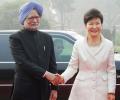
South Korean President Park Geun-hye's visit to India will enhance economic and military ties between the two countries and give the relationship a strategic dimension, says Jiye Kim.
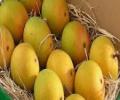
UK environment minister Lord de Mauley hosted a round-table meeting here with representatives of mango and vegetable importers and exporters from the UK and India, Deputy Indian High Commissioner to the UK Virendra Paul, and senior regulators from Defra and the Food and Environment Research Agency.

2014 will be a watershed election. Much is at stake and much needs to be changed. Women need their voice to be heard and they need representation with real power, says Sunanda Vashist.

Xi Jinping has accumulated great power, but he faces trials that are just as great, says Claude Smadja.

'By 2020 around 34% of India's population will be in the 15-34 age group.' 'More than 70% of them live in rural areas.' 'Their energy and enthusiasm need to be tapped in order to meet their aspirations and transform agriculture and the rural economy,' says P K Joshi.

'A CEO is successful if he is able to retain the confidence of his shareholders. And the shareholders of India Inc have backed their prime minister-CEO to the hilt,' says Sudhir Bisht.
The National Democratic Alliance government is weeding out independent directors on the boards of public-sector undertakings (PSUs).

The Chinese leader will display his grip on the Communist party and chart his plans for his country's future.
Filing with inadequate disclosure of assets will be liable for prosecution

A combative Congress President Sonia Gandhi on Wednesday mounted a blistering attack on Prime Minister Narendra Modi, accusing him of running a government "of some people, by one person for a select few" and said he has not much to showcase even as the government completes one year.

India needs to tread cautiously on the growth path.
'Tax dodging through tax havens is one of the ways multinational corporations and the super-rich in India are using to evade taxes.'

'Mr Modi has inherited a system that taxes businessmen and fritters the money away over ministries.'

'The Opposition has no option but to make it an 'All versus One' fight to even think about winning.'

Saroj Kumar Rath, author of the newly-published book Fragile Frontiers: The Secret History of Mumbai Terror Attacks, speaks to Rediff.com's Vicky Nanjappa.
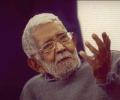
When Rajni Kothari pointed towards a new democratic alignment in India.

Is it just the glamour?

Instead of a consumption stimulus the government must address the NPA issue with a war footing and invest in infrastructure, affordable housing and exports, says Sanjeev Nayyar.

The Supreme Court and its committees, the two states and the central government must become objective and take the present and not just the past in mind.

'Four years into his tenure and Modi still has no idea what is wrong with the agriculture sector!'

Prime Minister Narendra Modi is in Tanzania where he held talks with Tanzanian President John Pombe Joseph Magufuli.
'If Modi arrived like a juggernaut, he left like a jigsaw puzzle whose pieces were being dismantled bit by bit. It was as if India had seceded quietly from him.' Shiv Viswanathan's social science fiction about what India would be like in 2020.
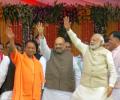
The BJP's manifesto for UP elections promised many things. But, given the state's precarious financial position, fulfilling these promises is likely to prove tricky, says Ishan Bakshi.

Terrorism and Afghanistan were the focus points of Prime Minister Narendra Modi's talks with Uzbek President Islam Karimov on his first visit to Central Asia.

The amount is around a fifth of the cumulative investment in fixed assets by these companies.

Annabel Mehta, Sachin Tendulkar's mother-in-law, has dedicated her life to working with the Beautiful People of the other half of Mumbai without whom the city would neither exist nor thrive. Vaihayasi Pande Daniel met the amazing lady who was awarded the Member of the Order of the British Empire for her service to underprivileged communities.

Ajit Balakrishnan recalls some lessons from the last time people talked of 'convergence' -- the mid-1990s.

Modi govt must implement few policy measures which it announced in Budget 2015.

Accusing the United Progressive Alliance government of "heaping hardships on people," Tamil Nadu Chief Minister J Jayalalithaa flayed its "knee-jerk" reaction of increasing Foreign Direct Investment cap in different sectors and warned that its "insensitivity" towards people will take its toll soon.

The year gone by saw the high and mighty of the corporate world face the music in the Delhi High Court which held that the telecom majors are amenable to CAG audit and Mukesh Ambani's RIL struggling hard to get rid of an FIR lodged on gas pricing by the 49-day-old AAP regime.
